How Valtaris reads a thread
Valtaris is not a summary of a thread. It is a set of findings, each one traceable to the comments behind it. Here is how a thread becomes a report, and the rules each step follows.
A summary tells you what a thread is about. A Valtaris report tells you what the people in it concluded, how many of them, who disagreed, and lets you check every claim against the comment it came from.
The examples below come from a real report on a 224-comment r/whoop thread, “Apple almost killed whoop.”, which we also worked through in How to read a Reddit thread without fooling yourself.
One rule behind all the others
Anything that can be counted or checked is done by code, not by the AI. The AI reads the comments, judges which ones say the same thing, and writes the findings in plain sentences. Counting people, removing duplicates, matching quotes to the original text and laying out the report are all done by ordinary code, so they come out the same way every time.
1Capture the whole thread
You open the thread you care about and capture it with the Valtaris Chrome extension. It collects the entire comment tree, including replies hidden behind “load more”, with each comment’s score, date and link. If Reddit shows more comments than could be captured, usually deleted or collapsed ones, the report says how many are missing.
Valtaris doesn’t crawl Reddit or watch subreddits. It only reads threads you choose.
2Remove what isn’t a view
Deleted and removed comments, bots, moderator notices and repeated text from the same person are filtered out by rule. Then each remaining comment is read for what it is: a thank-you, a bare “this”, an off-topic aside, or a promotion is set aside. A bare agreement isn’t thrown away; it is kept as support for the comment it replies to.
3Pull out each point, with the exact words
Every comment is read with the comment it replies to, because “same” or “not for me” mean nothing on their own. Each point a commenter makes becomes a piece of evidence: the exact quote, what kind of point it is (a complaint, a recommendation, a question, a workaround), and whether the person is speaking from their own experience.
Each quote is checked against the original comment immediately. It must match word for word, or match once spacing and punctuation are normalised. If it doesn’t, the quote is extracted again; if it still doesn’t match, it is dropped. In the r/whoop report, 259 pieces of evidence were extracted: 208 matched word for word, 51 after normalising, and none had to be dropped.
4Group the points and count the people
Points that say the same thing are grouped into a candidate finding. Then code counts, for each one:
- Independent voices: different people who said it, each counted once however many times they posted.
- Agreeing replies, counted separately from people who made the point themselves.
- Counterpoints and conditions: people who disagreed, or said it only holds in some cases.
- Where and when: which threads and dates the evidence comes from.
From those counts each finding gets a confidence level. A finding from a single thread is capped at medium, however many people said it, because one community is still one community.
5Write findings only from their evidence
Only now does the AI write each finding as a sentence, using the evidence in its group and nothing else. It picks the quotes to show, preferring specific, well-supported ones. It can lower a finding’s confidence if the evidence is weaker than the count suggests, and must say why; it can never raise it.
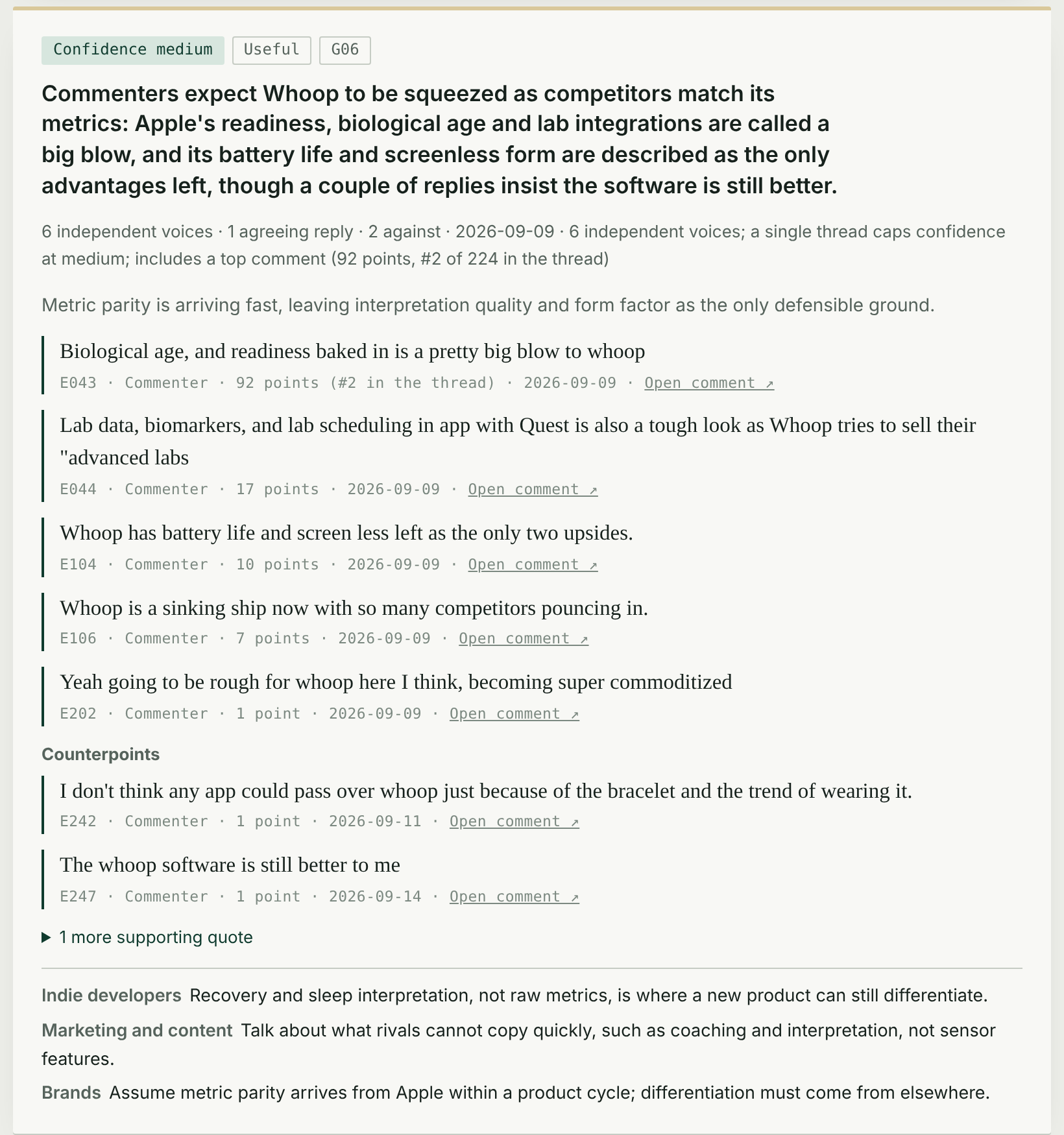
6Check that the evidence supports the claim
Before the report is assembled, every link between a finding and a piece of evidence is checked again: does this quote support this sentence, partly support it, or not support it? Links that don’t hold are removed and the counts are recalculated. In the r/whoop report, 145 links were reviewed and 10 removed.
A finding left with too little support doesn’t disappear silently. It moves to a separate Weak signals section: possibly an early sign of something, but not presented as a conclusion. Every takeaway at the top of the report must point to at least one finding below it; a takeaway that can’t is cut.
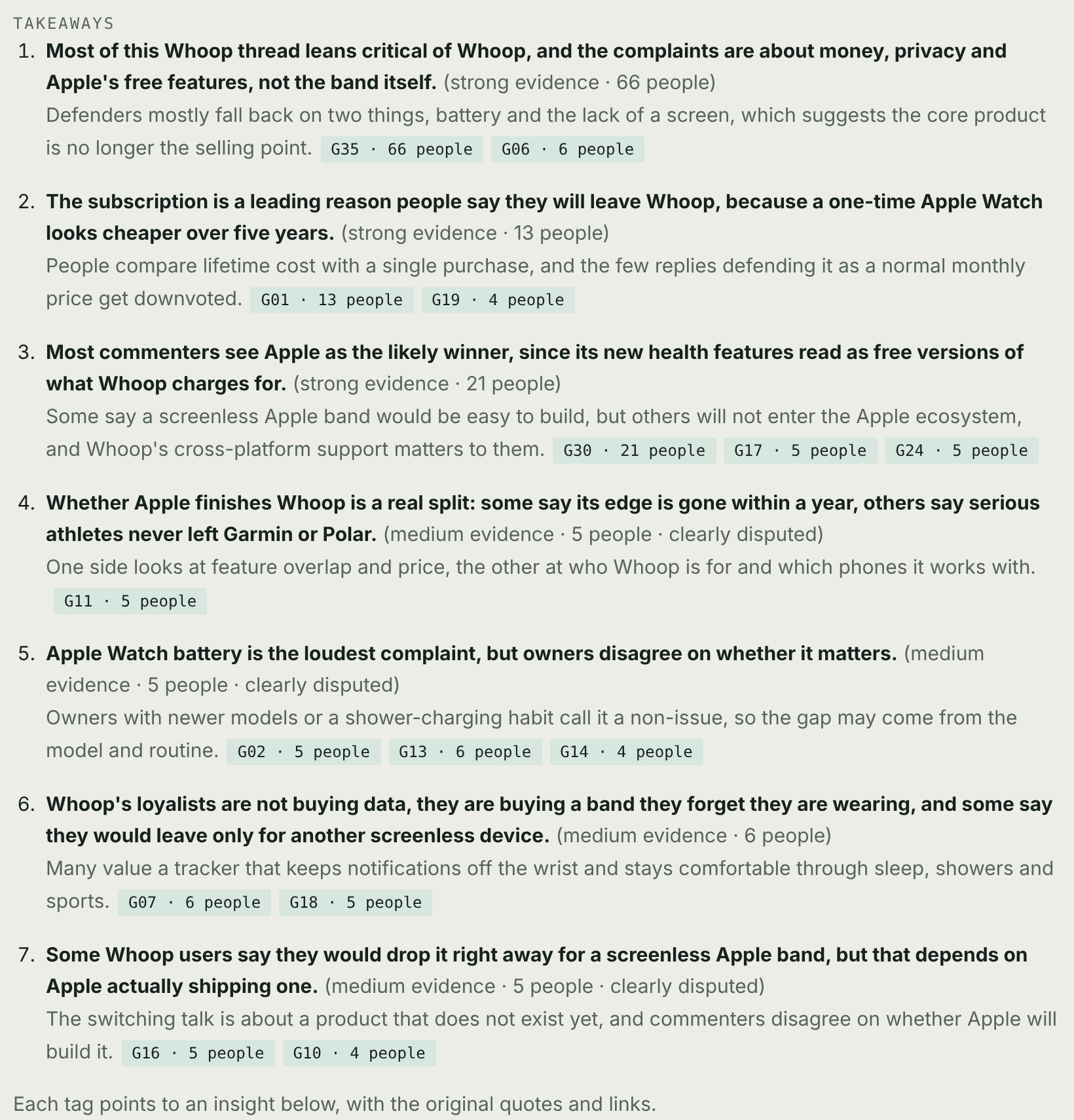
What a report contains
- Takeaways: a handful of plain conclusions, each with its evidence level and number of people.
- What the thread is really about: the question on the surface, and the one underneath.
- What people agree on, and where they split: disputed findings show the strongest evidence from both sides.
- Findings by section, such as problems, alternatives, and how brands are rated, each with quotes and links.
- Weak signals, kept apart from the findings.
- About this data: the limits of this particular thread, written for it, plus the quote and evidence checks above.
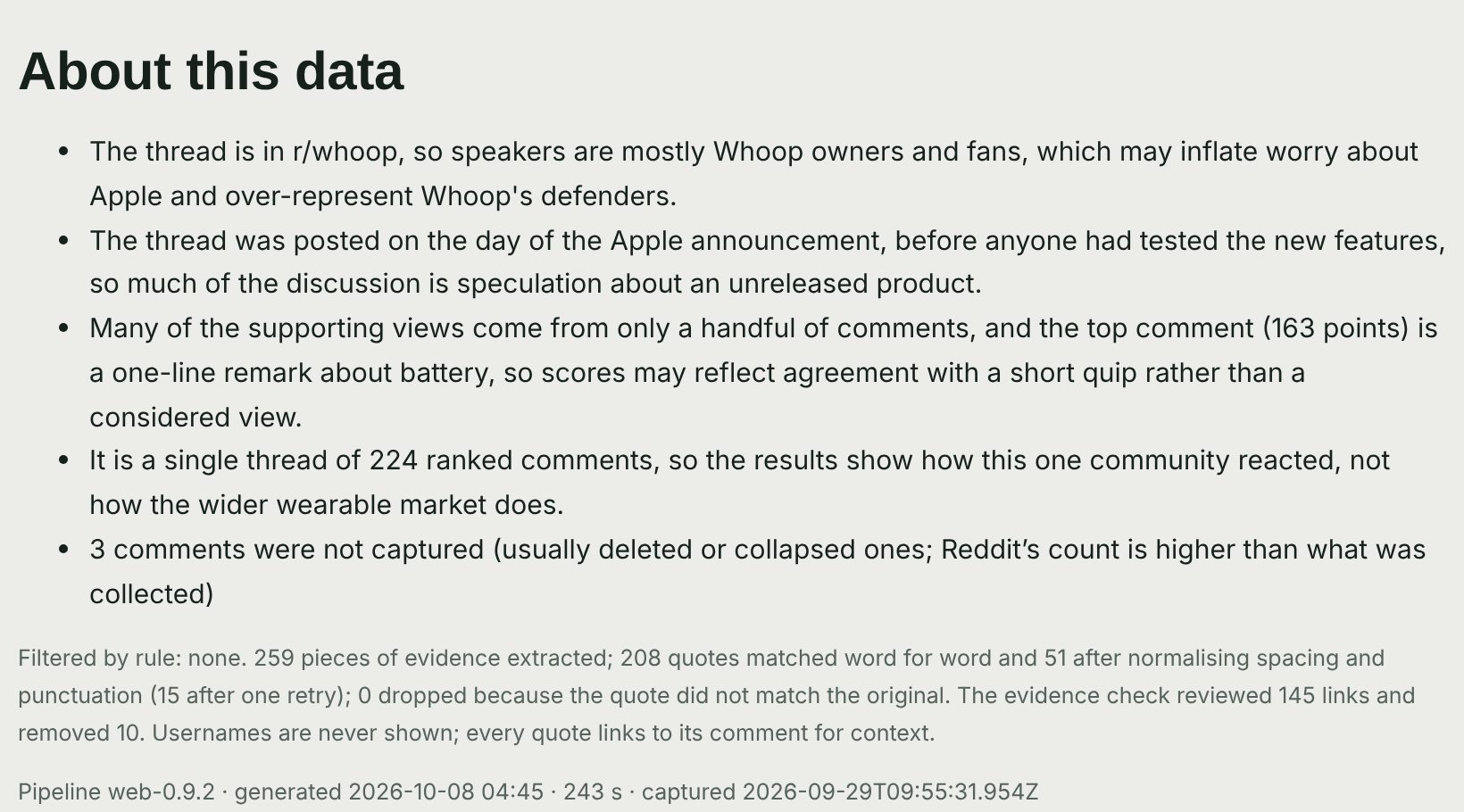
From there you can combine several threads into a research topic, or read a report against your own product.
What Valtaris is not
- Not a summary. A summary compresses a thread. A report separates claims from evidence so you can check them.
- Not monitoring. It reads the threads you choose. It doesn’t watch subreddits or send alerts.
- Not about individuals. Reports describe what a group said. Usernames are never shown; every quote links to its comment for context.
- Not a market survey. A thread shows how one community reacted. People who complain post more than people who are happy, and a report says so.
The AI steps involve judgement, especially deciding which comments say the same thing, so two runs on the same thread can group a few points differently. That is why every number in a report links to the comments behind it: you never have to take a count on trust.
What happens to your data
The captured thread is used to build the report and then deleted. Reports keep short quotes with links back to Reddit, never usernames. Details are in our privacy policy.
Want to try it on a thread you are reading? Every new account gets 2 free analyses, covering the 200 most-upvoted comments of a thread. See pricing for the rest.